It is the first question almost every learner asks: how long does it take to learn Arabic? If you have searched for an answer, you have probably seen everything from "a few weeks" to "several years" — which is confusing and, frankly, unhelpful. The honest answer is that it depends far less on Arabic being a difficult language and far more on two things: what you actually want to do with it, and how often you practice.
For busy expat workers in the Gulf, this is genuinely good news. You are not trying to read classical poetry or pass a university exam. You want to greet people, handle a taxi, talk to your boss, shop without stress and feel at home in daily life. That kind of practical, everyday Arabic comes much faster than most people expect — often in weeks, not years. In this guide we will give you a realistic, honest timeline, from your very first words to holding a real conversation, so you can set goals that actually keep you motivated.
Why the timeline depends on your goal
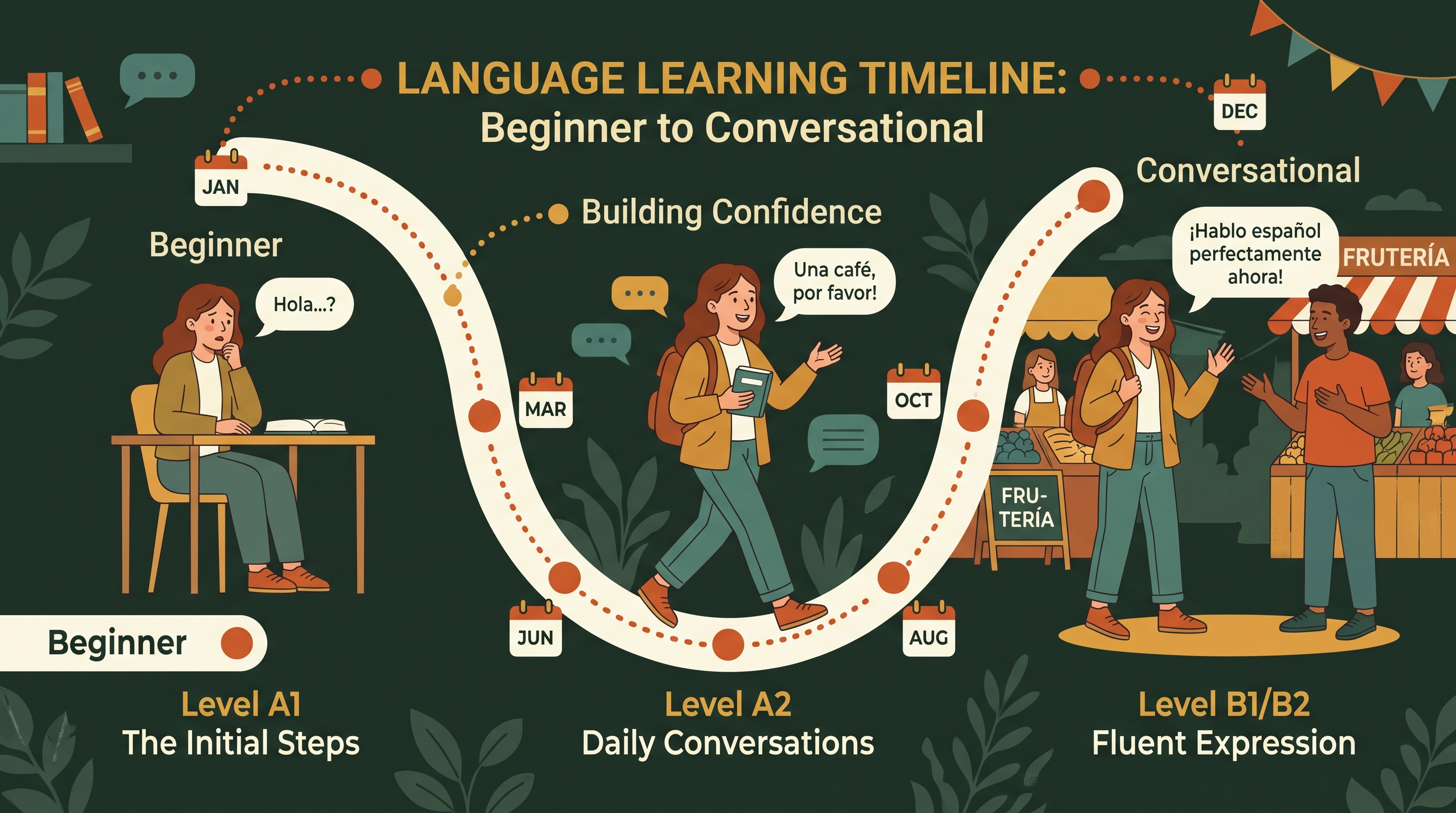
Before we talk about weeks and months, it helps to be clear about one thing: there is no single "learning Arabic." There are levels, and each level takes a different amount of time. Reaching the point where you can survive daily life is a completely different task from becoming fully fluent, and confusing the two is why so many people give up.
Here is a simple way to think about the levels most expats care about:
- Survival level — greet people, ask prices, give directions, handle simple work and home situations. This is where daily life gets easier, and it is closer than you think.
- Conversational level — hold a real back-and-forth, understand most of what is said in familiar situations, and recover when you do not know a word.
- Fluent level — discuss almost anything comfortably. Most expats never need this, and that is completely fine.
Week 1: your first useful words
In your very first week of daily practice, you can already learn enough to change how your day feels. You will not be having conversations yet, but you will be able to greet people warmly, be polite, and handle a handful of simple, high-value moments — which is exactly what builds the confidence to keep going.
A realistic first-week goal is a small set of phrases like these:
- marhaba — hello
- shukran — thank you
- min fadlik — please
- kayf halak? — how are you?
- khudhni ila… — take me to… (for a taxi)
- kam? — how much?
1 to 3 months: everyday survival Arabic
With consistent daily practice over one to three months, most learners reach survival level. This is the turning point where Arabic stops being something you are studying and starts being something you can use. At this stage you can shop and ask prices, direct a taxi, greet colleagues and understand simple instructions at work, and manage basic exchanges at home or in your neighbourhood.
You will still make plenty of mistakes, and that is completely normal — nobody speaks perfectly at this stage. What matters is that you can get things done and people understand you. For most expat workers, survival level is already life-changing: it removes the daily friction and stress of not being understood, and it earns you genuine goodwill from the people around you who see that you are making an effort.
3 to 6 months: real conversations
Keep practicing daily and, somewhere between three and six months, something wonderful happens: conversations start to flow. You understand more of what you hear, you can express yourself in a wider range of situations, and — crucially — you learn how to keep going when you do not know a word, by describing it or asking. This ability to "repair" a conversation is what separates someone who has memorized phrases from someone who can actually talk.
This conversational level is what most expats are really aiming for, and the important message is this: it is completely achievable without expensive classes or years of study. The learners who get here are not the most talented — they are the ones who kept practicing speaking, a little every day.
What makes some people faster than others?
If two people start at the same time, why does one reach conversational Arabic in four months while the other is still stuck after a year? It almost never comes down to talent. The people who progress fastest tend to share a few simple habits:
- They practice speaking out loud every day, even for just ten minutes, instead of studying in long, rare sessions.
- They focus on real, useful phrases tied to their actual life, not random vocabulary lists.
- They are not afraid to make mistakes and speak imperfectly — they treat every error as practice.
- They get feedback on pronunciation early, so bad habits do not set in.
The real secret: consistency over intensity
If you remember only one thing from this article, make it this: the single biggest factor in your timeline is not talent, and it is not some special course — it is how often you practice speaking. Ten focused minutes every day will take you much further than a three-hour session once a week. Language lives in the mouth and the ear, and it is built through frequent, small repetitions.
This is exactly why an AI voice tutor works so well for busy people. YalloTutor lets you practice real conversations any time — on your commute, on a break, or before bed. You can ask how to say something, hear it spoken in clear Gulf Arabic, see it written with transliteration, and repeat it until it feels natural, with gentle correction on your pronunciation along the way. It turns the ten spare minutes you already have into steady, real progress.
So, how long will it take you?
Here is the honest summary. With ten to fifteen minutes of daily speaking practice, expect useful survival Arabic within one to three months, and comfortable everyday conversations within three to six months. Push a little harder or practice a little more, and you will move faster. The one thing that guarantees slow progress is waiting for the "perfect" time to start — so start small, start today, and let consistency do the work.
Practice speaking Arabic today
YalloTutor is your personal AI voice tutor. Have real conversations, hear the pronunciation, and see every phrase written out — right on your phone.
Get the app